Clinical sheet · Face treatments

Facial scars: reading the texture before softening it.

A scar is the visible portion of a dermal lesion: repair cells concentrate on the injured area, multiply there and leave a particular texture on the skin. At the Photoderma clinic in Laval, we distinguish four families of facial scars and choose the treatment according to the texture, the colour and the depth.

Technician experienced in reading the dermis Injections under the responsibility of Dr. Yoel Moyal Medicard financing available

Origins cited in the clinic
Injury, burn, surgical incision or medical procedure.
Mechanism
Repair cells concentrate, multiply and create healing through scar formation.
Proteins responsible
Collagen and elastin — restore firmness and elasticity, encourage the reunion of skin fibres.
Why texture remains
Age, lifestyle, location and severity of the lesion influence the speed and the quality of scar healing.
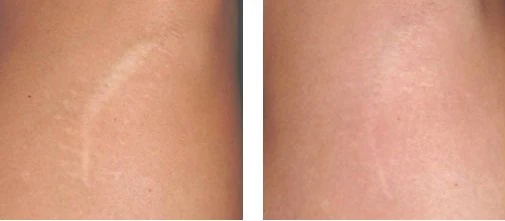
Clinical close-up of a facial scar before the assessment at the Photoderma clinic in Laval
Close-up of a scar before the protocol is chosen: texture, pigmentation and depth are assessed in the same session.

Four recognized families

Not all scars look alike.

The Photoderma clinical sheet names four categories of scars. Recognizing them guides the choice of treatment: smoothing a raised area, filling a depression, evening out pigmentation or reviving a too-pale zone.

01

Hypertrophic scars

Thick dermis.

They form a raised texture, often wider than the original wound. Scar tissue is produced in excess, creating a small firm bump that can be felt on palpation.

  • TextureRaised, bulging
  • PalpationFirm, dense
  • Care objectiveSmooth and soften

02

Atrophic scars

Form a depression from a lack of dermis.

On the contrary, they result from a deficit in tissue production. They hollow the surface: acne scars are the best-known variant on the face.

  • TextureDepressed
  • PalpationThin, pliable skin
  • Care objectiveFill and redensify

03

Hyperpigmented scars

Darker dermis.

The scar area appears browner or redder than the surrounding skin. The texture is sometimes minimal, but the colour remains visible long after the wound has closed.

  • TextureFlat or slight
  • ColourDarker than the skin
  • Care objectiveEven out pigmentation

04

Depigmented scars

Dermis paler than natural pigmentation.

This is the mirror of the previous type: melanin is missing at the site of the lesion. The scar remains lighter, sometimes pearly, and contrasts with the surrounding complexion.

  • TextureFlat
  • ColourPaler than the skin
  • Care objectiveRevive and harmonize

Two scars on the same face can belong to different families. The in-clinic assessment verifies this zone by zone before building the care plan.

Why scar healing is uneven

Collagen, elastin and personal conditions.

The production of collagen and elastin is responsible for scar healing. These proteins restore the firmness and elasticity of the skin by encouraging the reunion of skin fibres in the body's call to action for healing. Several factors influence the speed and the quality of the result.

  • a

    Age

    Young skin heals faster but sometimes produces too much collagen, creating hypertrophic scars. With age, the dermis makes fewer support fibres and repair takes place more slowly, more readily leaving a depression or a mark.

  • b

    Lifestyle

    Smoking, nutritional deficiencies, short sleep and chronic stress slow collagen induction. These factors cited in the clinic explain why the same injury can leave very different scars from one person to another.

  • c

    Location of the injury

    Some areas of the face are very mobile — around the mouth, chin, forehead — and are subject to constant tension on the dermis. This mechanical pull stretches the forming scar and alters its final texture.

  • d

    Severity of the lesion

    A superficial incision often leaves only a fine mark. A deep burn, a wide wound or a surgical procedure affecting several layers of the dermis produces more pronounced, sometimes irregular, scar healing.

It is the combination of these factors that explains why it is now possible to soften scars, without promising their complete disappearance. The realistic goal is to make the texture, the colour or the depression less visible to the eye.

Related treatments

Softening options available in Laval.

The clinical sheet names mesotherapy and microneedling as the direct associated protocol. In practice, the team combines several technologies available on site to cover every scar family: texture, depression, pigmentation.

Associated protocol cited

Mesotherapy / Microneedling

Controlled micro-perforations that restart the production of collagen and elastin deep in the dermis, then delivery of targeted actives (hyaluronic acid, peptides, vitamins). Protocol of choice for atrophic scars and to globally redensify the scarred dermis.

Preferred target Atrophic scars · irregular textures

See the Mesotherapy / Microneedling sheet

Pigment

Photorejuvenation / IPL

Intense pulsed light to fragment overly dark pigments and even the complexion around a scar. Useful as a complement when the family is hyperpigmented or when the scar area leaves persistent redness.

Preferred target Hyperpigmented scars · red marks

See the Photorejuvenation / IPL sheet

Deep collagen induction

Potenza (RF microneedling)

Radiofrequency microneedling: the needles deliver controlled energy at depth to densify the dermis. Technology installed in the clinic, relevant for atrophic acne scars and mixed textures.

Preferred target Stubborn atrophic scars · mixed textures

See the Potenza sheet

Surface & grain

AHA / BHA Peel

Peels based on AHA and BHA acids accelerate cell renewal. They refine the skin texture around the scar, soften very superficial raised areas and prepare the zone for deeper treatments.

Preferred target Superficial scars · upkeep between protocols

See the AHA / BHA Peel sheet

Fill a depression

Dermal filler

For a localized atrophic scar, hyaluronic acid injected under the depression restores volume and flattens the visible surface. Injections are performed under medical responsibility.

Preferred target Isolated atrophic scars · single depressions

See the Dermal filler sheet

An experienced technician will give you all the information needed about our various treatments. Injectable procedures fall under Dr. Yoel Moyal, the clinic's physician responsible for injections.

Before / during / after the treatment

What really changes on the skin.

Soften, not erase

The clinical sheet speaks of "softening your unwanted scars." The realistic goal of the protocols is to make the texture less visible, even out pigmentation and give the skin a more regular look — rarely to remove every trace.

A multi-session plan

Scar healing is a long biological process: most softening protocols require several sessions spaced several weeks apart, to give collagen and elastin time to rebuild between two stimulations.

An assessment first

Every first visit at Photoderma starts with reading the skin and classifying the scar in one of the four families. Only then does the technician select the best-suited protocol.

Medicard financing

Medicard financing is available on all medical-aesthetic treatments, including scar-softening plans: payment in 6 or 12 months, with no upfront fee, application processed in the clinic with a reply generally the same day.

Before the consultation

Frequently asked questions · Facial scars

What is a scar and how does it form?

A scar is the visible portion of a dermal lesion after the tissue has repaired itself following an injury, a burn, a surgical incision or a medical procedure. Repair cells concentrate in the area and then multiply. This action leaves a particular texture on the skin.

What are the four types of scars distinguished in the clinic?

Photoderma distinguishes four families: hypertrophic scars (thick dermis, raised), atrophic scars (depressed, from a lack of dermis), hyperpigmented scars (darker dermis) and depigmented scars (dermis paler than natural pigmentation). Each family calls for a different care strategy.

Why doesn't scar healing always succeed in repairing the dermis?

Scar healing depends on the production of collagen and elastin. Several factors influence its quality: age, lifestyle, the location and the severity of the injury. When these conditions are not met, the lesion leaves raised texture, a depression or a different tone.

Which treatments does Photoderma offer to soften facial scars?

The clinic uses several complementary options: IPL photorejuvenation for colour, mesotherapy and microneedling for texture, AHA/BHA peels for the surface, dermal fillers for atrophic scars and Potenza for deep collagen induction. The plan is set after the assessment.

Who meets with you to plan the treatment of my scars?

An experienced technician welcomes you in the clinic to read the skin, identify the scar family and give you all the information needed on each option. For injectable procedures, Dr. Yoel Moyal validates the protocol. Medicard financing is available on all treatments.

Next step · reading the skin

Have your scars classified before choosing the treatment.

The consultation identifies the family, measures the texture, checks the pigmentation and selects the right sequence: mesotherapy/microneedling to redensify, IPL for colour, Potenza for a deeper dermis, peel for the surface, filler for a specific depression. Medicard financing is available on all medical-aesthetic treatments.

Scar reading by appointment · Photoderma clinic, 4672 Blvd. Saint-Martin Ouest, Laval, Québec H7T 2X9 · ste-dorothee@photoderma.ca