Permanent hair removal · Since 1916 · Filament by filament

Electrolysis: the pioneer of permanent hair removal, hair by hair.

Electrolysis inserts a fine filament into the hair's ostium to send an electric current into the hair bulb. The dead hair is then removed with tweezers. Unlike laser, it works on every hair type — white, pale, red, vellus — and remains safe on dark, olive and tanned skin.

Photoderma · 4672 Blvd. Saint-Martin Ouest, Laval, Québec H7T 2X9

Detail · Mechanism · Current in the filament

What exactly happens inside each hair?

Using a filament inserted along the hair, the electrologist delivers an electric current into the hair bulb. The root is disabled, then the dead hair is removed with tweezers. The operation is carried out follicle by follicle, in whatever order the operator chooses.

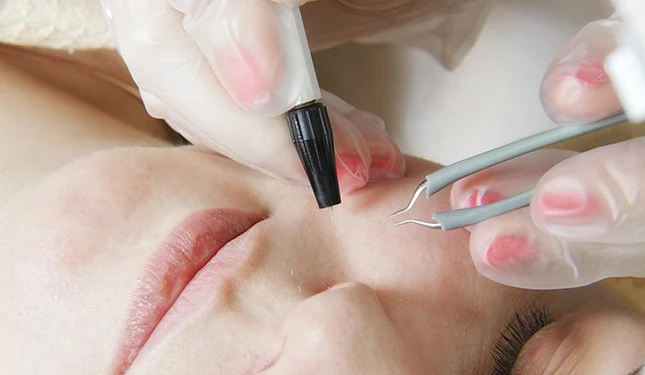
Electrolysis session: filament and tweezers, hair by hair
Electrolysis in clinic: filament and tweezers, hair by hair.
  1. 01

    Filament insertion

    A very fine filament is slid along the hair, into the follicular ostium, down to the bulb. No puncture: the filament follows the hair's natural canal.

  2. 02

    Electric current

    A pulse of current is delivered into the hair bulb. A slight pinch is felt at the precise moment the current passes through the hair.

  3. 03

    Removal with tweezers

    The dead hair is then removed with tweezers. The operator moves on to the next hair and repeats the operation across the whole area.

  4. 04

    Several passes

    The electrologist must pass over the same follicle several times for it to be fully eliminated. This is the key to a permanent result.

"Electrolysis is a method that has been proven since 1916. It was invented by a professor of French origin who turned it into a hair-removal method." — Photoderma source sheet, rephrased.

Detail · Candidates · Hair and skin involved

Which hair and which skin does electrolysis change the game for?

It acts where the laser cannot read its target. Unlike a light beam, the current does not depend on the hair's melanin or on the skin's phototype: it simply travels down the follicle's canal.

Hair side

All hair types and colours

  • White hair Depigmented, invisible to laser.
  • Pale or blond hair Melanin too faint for the beam.
  • Red hair Pheomelanin is not optically readable.
  • Vellus Follicles too fine for laser.
  • Residual dark hair To clear the last ones after a laser series.
Skin side

Every complexion, tan included

  • Dark skin No light absorption to worry about.
  • Olive skin As suitable as very fair skin.
  • Tanned skin No postponement due to recent pigmentation.
  • Ultra-fine areas Earlobe, cheekbones, around the eyes.
  • Fitzpatrick V · VI A safe alternative to Alexandrite.
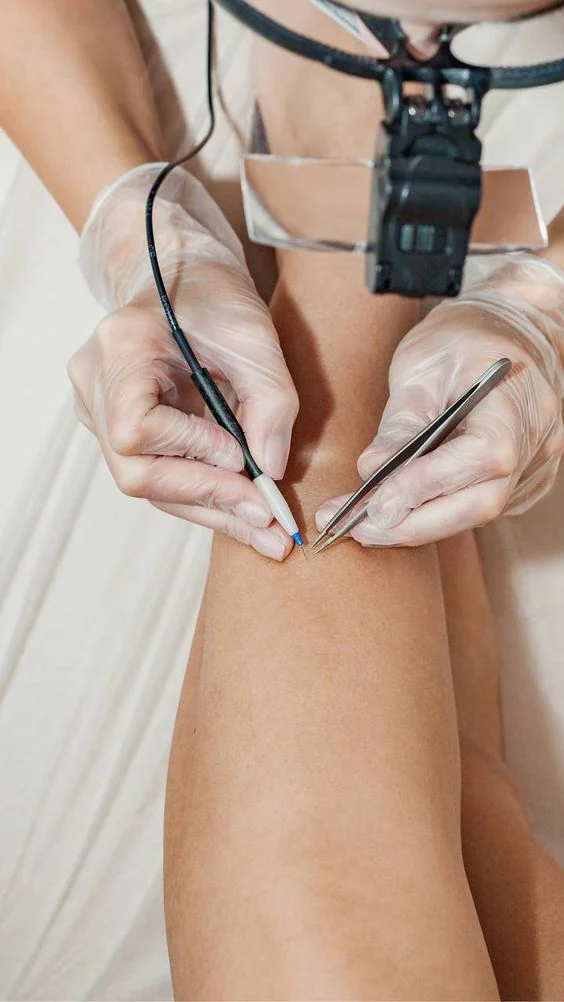
Illustrative view of an electrolysis hair-removal session at the Photoderma clinic, Laval
Photoderma archive image Electrolysis in session, hair by hair.

In Photoderma practice. Electrolysis is still used today to clear the last remaining hairs after laser sessions. It is the tool that closes the series: it addresses what light leaves behind.

Detail · Session · Comfort and preparation

What to expect during an electrolysis session?

A slight pinch is felt at the moment the current passes through the hair. The intensity is brief and local: no heat spread across the whole area, no device noise. The operator works at your pace, commenting on each pass, and can pause the session on request.

  • Before the session

    Clean skin, no make-up or oily cream on the area. Avoid waxing or tweezing in the weeks beforehand: the hair must be present in its follicle to be treated.

  • Personalised comfort

    More sensitive clients can apply a numbing cream sold at the pharmacy, such as Emla cream, about 30 minutes before the appointment. The effect sets in after about half an hour and makes longer sessions easier.

  • After the session

    Small pink spots may appear here and there. Avoid direct sun exposure and irritating products (acids, exfoliants) on the area for 24 to 48 hours so the skin can close up calmly.

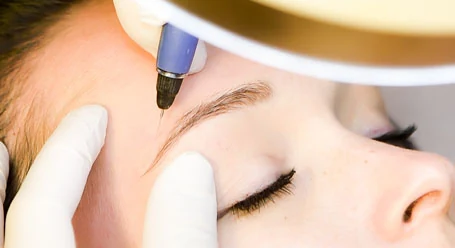
Illustrative view of an electrolysis treatment at the Photoderma Laval clinic, hair by hair
Photoderma archive image "A slight pinch will be felt at the moment the current passes through the hair."
— Photoderma source sheet, rephrased.

Detail · Planning · Pace of the series

Why several passes, and how to organise the sessions?

Because these are treatments that permanently eliminate unwanted hair, they call for careful planning of the sessions over time. The electrologist must pass over each hair several times: the root is not destroyed on the first pulse.

Typical pace

  • Initial session Visual assessment of the area, comfort test, first pass.
  • Follow-up appointments Passes spaced to match the hair's growth cycle and the extent of the area.
  • Maintenance sessions Shorter, more widely spaced: we finish the hairs that come through on the next cycle.
  • Closing the series When the area stops producing new adult hairs.

Clinical promise

An excellent permanent, definitive method for anyone who wants to be done with unwanted hair once and for all.

  • Permanent A fully treated follicle will no longer produce hair.
  • Definitive Unlike wax or an epilator, the hair does not come back within a few weeks.
  • Progressive The area clears with each series: you can see the density visibly drop.

An experienced esthetician will give you all the information you need about our treatments during the in-clinic assessment.

Financing The Medicard program is available on all of the clinic's medical-aesthetic treatments, over 6 or 12 months with no upfront fee. The application is completed in clinic and the answer usually comes the same day.

Navigation · Other hair-removal treatments

The other hair-removal paths at Photoderma.

The source sheet points to two laser options, useful when the skin and hair meet the optical conditions. We regularly combine the three tools in the same protocol.

Laser · 1064 nm

Nd:YAG Laser

For dark, olive and mixed-tone skin (phototypes V and VI). The optical target is not melanin but the hemoglobin of the feeding vessel at the hair root: skin colour does not absorb the beam.

Laser · 755 nm

Alexandrite Laser

For fair skin carrying dark hair (Fitzpatrick phototypes I to IV). A short wavelength highly affine to the hair's melanin, heat contained in the follicle, comfort ensured by the built-in cryogen.

Overview

The three paths side by side

Comparison of methods, areas treated, expected comfort and recommended sequence. Useful for choosing before the consultation or for combining electrolysis with a laser.

Before your assessment

Frequently asked questions · Electrolysis

What is electrolysis hair removal?

Electrolysis is the insertion of a fine filament into the hair's ostium to deliver an electric current that disables the root. The electrologist then removes the dead hair with tweezers. The method has been proven since 1916 and works filament by filament, without depending on pigment.

Why choose electrolysis over laser?

Because it works on hair the laser cannot read: white, blond, red and vellus. It is also safe on dark, olive or tanned skin, which would absorb an Alexandrite beam. In the clinic, it is used to clear the last remaining hairs after a laser series.

Does electrolysis hurt?

You feel a slight pinch at the moment the current passes through the hair, lasting only a few seconds. More sensitive clients can apply a numbing cream sold at the pharmacy, such as Emla cream, about 30 minutes before the appointment at the clinic.

How many passes are needed per hair?

The electrologist must pass several times over the same follicle before it is completely eliminated, because the root is not destroyed on the first pulse. That is why permanent hair removal requires careful planning of sessions over time, hair by hair.

How long has electrolysis been practised?

Electrolysis has been used since 1916. It was invented by a professor of French origin who turned it into a hair-removal method. It is the pioneer of permanent hair removal, and it is still used today for hair or skin that modern lasers cannot treat.

Next step · Assess the area

Have the area assessed before committing to the first session.

For electrolysis, the key step is not a phototype test — it is a visual inspection of the area: hair density, filament fineness, growth map. An experienced esthetician estimates the passes required and proposes a realistic pace. Medicard financing applies to the entire series, over 6 or 12 months with no upfront fee.

The assessment is brief and comes with no commitment. It also allows you to choose, where appropriate, a combination of electrolysis + laser.