A
Pigmentation spots (brown spots)
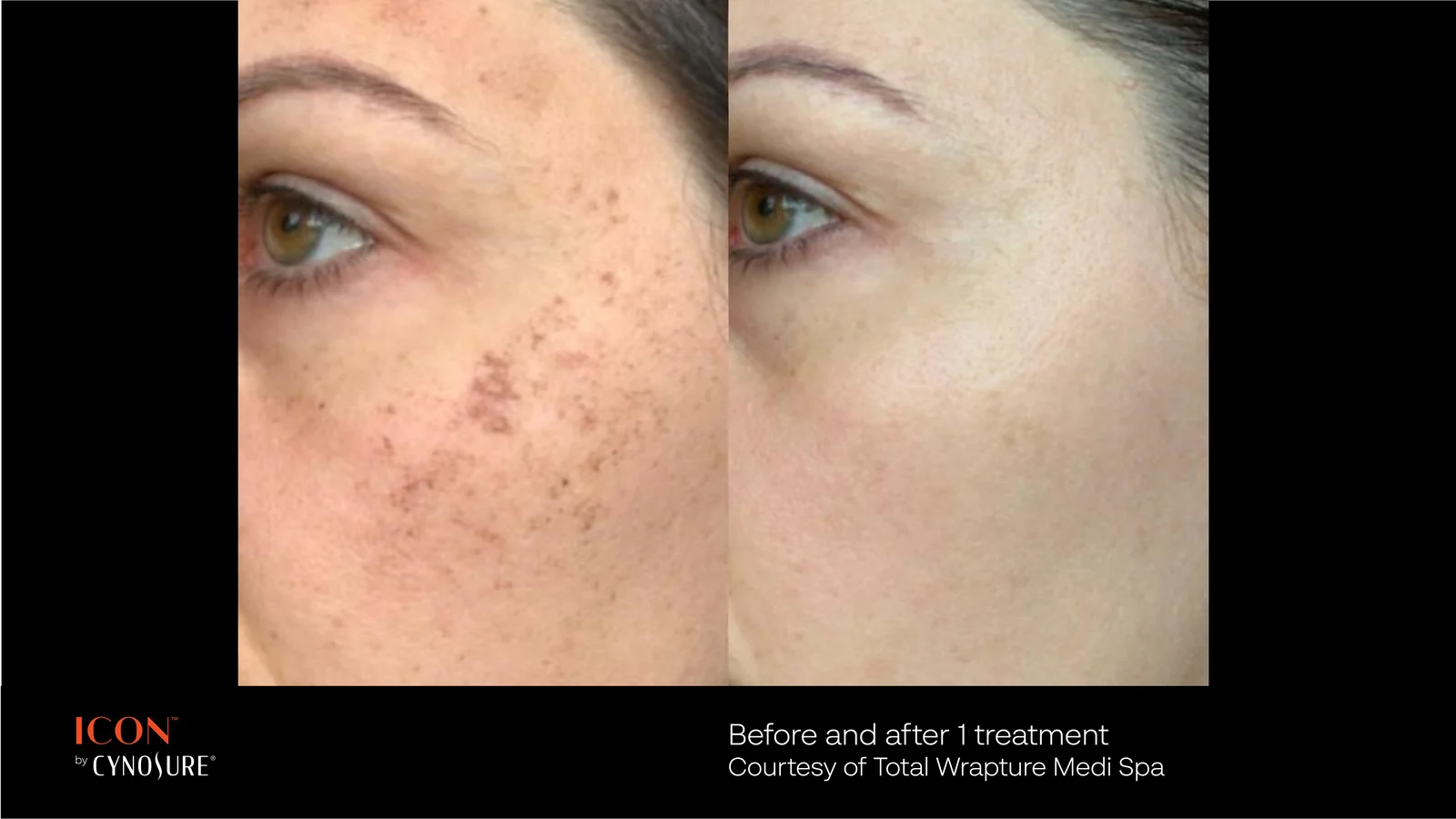
Caused by sun exposure, aging and other environmental or genetic factors, brown spots respond well to a photofacial. IPL targets the excess pigment to even out the complexion of the face, hands and décolleté.
Face treatments · Intense pulsed light
Photorejuvenation — also called a photofacial — uses intense pulsed light (IPL) to soften pigmented and vascular irregularities. At the Photoderma clinic, calibrated pulses treat the face, neck, décolleté, arms, legs and back; the same tool acts on brown spots, redness and acne breakouts all at once.
How it works
The treatment consists of sending pulses of light to the area to be treated. Two main targets absorb this energy: melanin, the skin's pigment, and hemoglobin, the pigment of blood vessels. IPL acts on both in a single session.
Pigment target
At the moment of the pulse, the melanin responsible for skin pigment captures the light energy. IPL thereby treats the cells that cause pigmentation or uneven coloring. Brown spots rise to the surface and then gradually flake off.
Vascular target
The same tool also acts on the dilated blood vessels that cause redness. The light selectively heats these micro-networks visible on the cheeks, the sides of the nose and the décolleté without affecting neighboring tissues.
Bacterial and reparative target
For acne, the light directly treats the bacteria responsible and delivers oxygen to the skin, which supports cutaneous repair. IPL thereby becomes a third lever: fewer active breakouts and a more even complexion.
Three main indications
The clinical fact sheet for the photofacial groups together three major families of indications. In practice, several of them coexist in the same person — the IPL session makes it possible to manage them at the same time.
A
Caused by sun exposure, aging and other environmental or genetic factors, brown spots respond well to a photofacial. IPL targets the excess pigment to even out the complexion of the face, hands and décolleté.
B
The dilation of blood vessels visible on the face can be treated with photorejuvenation. The light energy closes these micro-vessels and softens the persistent redness on the cheeks and the sides of the nose.
C
This light-based treatment can also help with acne by acting directly on the bacterium that causes it. The oxygen delivered to the skin supports cutaneous repair and complements a topical routine supervised by the clinic.
For whom? The photofacial can be performed on women, men, and teenagers accompanied by a parent. The assessment first specifies any possible contraindications: pregnancy, a phototype that is too dark, recent tanning, use of photosensitizing medications.
Flow and aftercare
The number of treatments required varies from one person to another. Generally, one to three sessions at a four-week interval are needed; the annual maintenance session keeps the effects going. After each session, photoprotection is not an optional extra: it is part of the protocol.
Day 0
Skin reading, history, areas to treat. The technician confirms the IPL indication and calibrates a discreet test spot when the phototype or history calls for it.
3 to 5 sessions
Each session adjusts the intensity to the area (face, neck, décolleté, arms, legs, back) and to the target of the day: pigmentation, redness, or active breakouts. Passes keep to an interval of about four weeks.
24–72 h
The targeted spots rise, darken slightly and then flake off over several days. The skin must not be scratched or mechanically exfoliated; the complexion gradually becomes more even.
Daily
A broad-spectrum SPF 50 sunscreen is required after a photofacial. It secures the result, limits the risk of rebound pigmentation, and prolongs the effect of each session.
Each year
It is recommended to maintain the skin once a year with this treatment. One IPL pass per year is generally enough to keep the complexion even once the initial protocol is complete.
Before the session
Photorejuvenation, also called a photofacial, uses intense pulsed light (IPL) to deliver calibrated light pulses to the skin. Melanin absorbs this light and treats the cells responsible for pigmentation; the same energy acts on the dilated blood vessels that cause redness.
IPL can be performed on the face, neck, décolleté, arms, legs and back. Each session adapts the intensity and spot size to the area being treated. The in-clinic assessment specifies which areas to prioritize and the order in which to treat them based on pigmentation and redness.
The number varies from one person to another, but generally one to three sessions spaced four weeks apart are planned. An annual maintenance session is recommended to prolong results. The precise schedule is set during the consultation after a skin reading and review of indications.
The photofacial can be performed on women, men, and teenagers accompanied by a parent. The assessment identifies any possible contraindications — pregnancy, a phototype that is too dark, recent tanning, use of photosensitizing medications — before any light-based protocol is started.
A broad-spectrum SPF 50 sunscreen is mandatory after a photofacial. Adding a high-performance vitamin C in the evening — AlumierMD's EverActive C&E at the clinic — helps maintain the glow achieved. Avoid tanning, saunas, and aggressive exfoliants for a few days.
Next step · testing the light
At the clinic, the team reads your pigmentation, listens to your redness, and assesses contraindications before suggesting an IPL schedule — one to three passes spaced four weeks apart, then an annual maintenance session. AlumierMD vitamin C can be integrated into the evening routine.
Clinic Photoderma · 4672 Blvd. Saint-Martin Ouest, Laval, Québec H7T 2X9 · Medicard financing available on all medical-aesthetic treatments.