Face treatments · Small growths

Skin tags: remove them in an aesthetic setting, without a dermatology detour.

The statistics cited in clinic make it clear: 40% of the world's population lives with skin tags, those unwanted little growths tucked into the skin folds. In Québec, their treatment is permitted in an aesthetic setting — at Photoderma in Laval, thermocoagulation is enough, with no dermatology appointment required.

Many wrongly believe removal belongs to the medical sphere. The clinical record is a reminder that it is indeed authorized in an aesthetic treatment room, provided an experienced technician first confirms the nature of the growth.

Prevalence cited in clinic
40% of the world's population lives with skin tags.
Main areas
Skin folds: neck, armpits, breasts, groin, sometimes the face and eyelids.
Québec framework
Treatment permitted in an aesthetic setting — no mandatory dermatology detour.
In-clinic technique
Thermocoagulation performed at Photoderma.
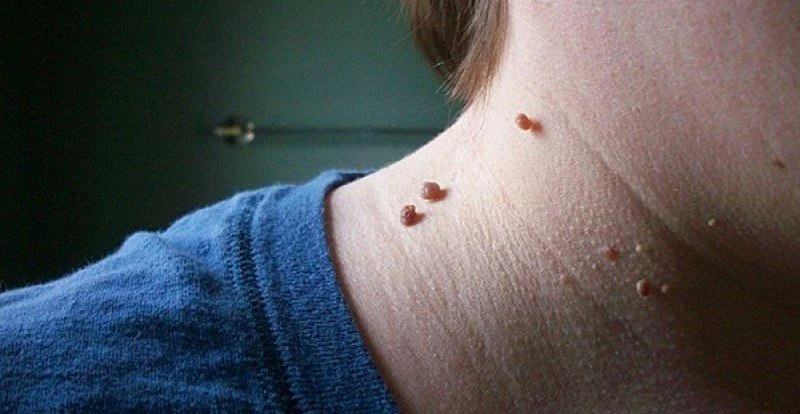
Clinical close-up of skin tags before their removal by thermocoagulation at the Photoderma clinic in Laval
View of skin showing several skin tags in a skin fold — assessment precedes any removal.

What is a skin tag?

A small, benign but stubborn skin growth.

The Photoderma clinical record is clear: the exact cause behind the formation of skin tags remains unknown to this day. Even if they are bothersome and unsightly, they are completely harmless. Recognizing them avoids confusion with other skin lesions.

  • Nature

    A pedunculated skin growth

    The skin tag — also called a "tag" — grows out of the skin on a thin stalk. It stays small, soft, skin-coloured or slightly darker. Nothing to do with a mole or a wart: the texture and the attachment are different.

  • Origin

    A cause still unknown

    No single trigger has been identified to this day. What we see most often are favourable terrains: hormones, excess weight, repeated friction in the skin folds. The in-clinic assessment is therefore done profile by profile, zone by zone.

  • Health impact

    Completely harmless

    Skin tags do not progress into a serious lesion and pose no threat to health. It is the day-to-day nuisance — clothing, jewellery, razor — and the look that motivate removal, not a medical risk.

  • Location

    Folds first, face second

    Most appear where the skin folds and rubs: neck, armpits, under the breasts, groin. The face and eyelids can also bear them, more discreetly. Each zone calls for a tailored in-clinic approach.

Where do they appear?

The preferred areas, in the order cited in clinic.

Skin tags appear mostly in skin folds. The face and eyelids come after, less frequently but always possible. Recognizing the area helps anticipate everyday gestures that irritate the lesion.

  1. 01

    The neck

    The most visible and most common area. Necklaces, closed collars and scarves rub against it continuously. Skin tags sometimes multiply in small clusters at the base of the neck or at the nape.

  2. 02

    The armpits

    Heat, perspiration and the razor keep up chronic irritation here. Skin tags stay hidden under clothing for a long time, then become a nuisance during shaving or hair removal.

  3. 03

    The breasts

    Under the inframammary fold or near the décolleté, skin tags settle in where the skin folds and rubs against lingerie. They become sensitive to dressing and to underwires.

  4. 04

    The groin

    The groin folds combine heat, humidity and friction. Skin tags grow slowly here, often discovered in the shower or during a maintenance hair-removal session.

  5. 05

    The face and eyelids

    Less frequent but more visible, skin tags on the face and eyelids require a meticulous touch. The assessment confirms it is indeed a skin tag before any intervention near the eye.

Who is most affected?

Five at-risk profiles, often combined.

The clinical record names five groups predisposed to the appearance of skin tags. These factors do not rule each other out: within the same profile, two or three can combine, which explains how skin tags can multiply quickly.

  • a

    Family history

    People who carry the genetic factors see skin tags appear earlier in life. If a close relative had many of them, the likelihood of developing them rises, often in the same areas.

  • b

    Adults over 40

    Frequency rises with age: past 40, the skin loosens in the folds and the friction mechanics intensify. Skin tags then multiply on the neck and armpits.

  • c

    Pregnant women

    The hormonal shifts of pregnancy encourage new skin tags, especially on the neck and under the breasts. They do not usually disappear on their own after delivery, and can be removed later in the treatment room.

  • d

    People who are overweight or obese

    Deeper skin folds concentrate heat, humidity and friction. This mechanical terrain encourages skin tags to form, sometimes in large numbers, in the same fold areas.

  • e

    People living with diabetes

    Diabetes is among the factors cited in the clinical record. The in-clinic assessment takes care to confirm the nature of the lesion: medical follow-up may be recommended alongside the aesthetic removal.

In people at risk, the recurrence rate remains high even after a successful removal. Regular follow-up allows intervention as soon as a new skin tag appears, before it grows larger and becomes bothersome.

Treatment paired with this concern

Thermocoagulation: how the clinic proceeds.

The Photoderma record names only one associated protocol for removing skin tags: thermocoagulation. An experienced technician provides all the required information before the session and tailors the gesture to each zone.

In-clinic protocol

Thermocoagulation

At our Photoderma medical-aesthetic clinic, skin tags can be treated effectively with thermocoagulation. Controlled heat cuts off the micro-circulation at the stalk, and the growth then detaches naturally.

  1. 1

    In-clinic assessment

    The technician confirms it is indeed a skin tag, identifies the areas to treat and verifies that there are no contraindications. The required information about the session and the aftercare is shared before any treatment.

  2. 2

    Targeted thermocoagulation

    A high-frequency heated stylus is applied to the base of the skin tag. The heat coagulates the tissue of the stalk: the growth loses its blood supply and dries up within a few days on the treated area.

  3. 3

    Aftercare and maintenance

    A small scab forms and then falls off on its own. Avoid scratching and protect the area from the sun while the skin heals. For at-risk profiles, follow-up allows new skin tags to be addressed as soon as they appear.

Thermocoagulation does not require general anesthesia and is performed entirely in the treatment room. The number of lesions treated in a single session depends on their size, their location and individual tolerance.

What to keep in mind before the appointment

Three facts that change the decision.

  • 40%

    Of the world's population

    You are not an isolated case: skin tags affect nearly one person in two worldwide, especially in the skin folds.

  • 0

    Dermatology detour

    In Québec, removal is permitted in an aesthetic setting. At Photoderma, the session takes place in the treatment room, with no medical office visit.

  • 1

    Associated protocol

    The clinical record names thermocoagulation as the only direct protocol. An experienced technician applies it zone by zone.

Before booking an appointment

Frequently asked questions · Skin tags

Do I need to see a dermatologist to have a skin tag removed?

No. In Québec, the clinical record confirms it: skin tags may be treated in an aesthetic setting. At Photoderma, an experienced technician performs the assessment and the removal in the treatment room, with no dermatology detour, provided the lesion is clearly a skin tag and not another type of growth.

Are skin tags dangerous to my health?

No. Skin tags are harmless. They remain bothersome, though: they catch on necklaces, underwear or razors, and disrupt the look of the skin. It is this everyday nuisance, not a medical risk, that leads most people to have them removed at the clinic.

Which areas of the body are most affected by skin tags?

The source record cites skin folds first: neck, armpits, breasts, groin. The face and eyelids can also be involved, more discreetly. Every session begins with a zone-by-zone review before thermocoagulation is applied.

Who is most likely to develop skin tags?

Five profiles stand out in the clinical assessment: people with a family history, adults over 40, pregnant women, people who are overweight or obese, and people with diabetes. These predispositions often combine several factors at once.

Can skin tags return after treatment?

Yes, in predisposed individuals. The clinical record specifies that the recurrence rate remains high after removal, even a successful one. Regular follow-up allows new skin tags to be treated as soon as they appear, before they reach a bothersome size.

Next step · say goodbye to skin tags

Have my skin tags removed in Laval.

The session at Photoderma begins with the in-clinic assessment: nature of the growth, areas involved, at-risk profile. Targeted thermocoagulation follows, in one or several passes depending on the number of skin tags. Medicard financing is available on all medical-aesthetic treatments.

Clinique Photoderma · 4672 Blvd. Saint-Martin Ouest, Laval, Québec H7T 2X9 · ste-dorothee@photoderma.ca